

Email Security Outcomes That Strengthen Your Organization

Prevention and detection are only the beginning. A true measure of an email security program is how effectively and consistently it responds when threats reach the inbox.

Choose the ORQET Deployment Model That Fits Your Organization

Organizations need a Post-Delivery Email Threat Response capability. ORQET delivers that capability through three deployment models. Each provides a different level of ORQET-managed response, allowing organizations to choose the model that best fits their needs.

Core

Customer-Executed Response

  • Human-derived verdicts
  • Consistent investigations
  • User verdict delivery
  • IOC reporting by email
  • Executive dashboard and reporting
  • Works with your existing report button

ADVANCED

Most Popular

Automated Response

  • Includes all Core features +
  • Automated Search and Purge
  • Customer-controlled Search and Purge
  • Threat Intelligence Platform access
  • Enriched IOC publication
  • Microsoft 365 integrations

INLINE

Coming Soon

AI-Initiated Detection

  • Includes all Advanced features +
  • Detection without a user report
  • Full visibility into AI action
  • Automated purge of AI-detected threats
  • Proactive threat detection
  • Multi-signal email analysis

Search and Purge: Automated and On-Demand Remediation

Search and Purge removes malicious emails from affected mailboxes after an ORQET verdict or can be used by security teams to search for and remove threats.

1

IDENTIFY

A malicious email is identified through an ORQET verdict or directly by the security team.

2

SEARCH

ORQET searches affected mailboxes to locate matching malicious emails, including copies that were not originally reported by users.

3

PURGE

Matching malicious emails are removed from affected mailboxes without requiring mailbox-by-mailbox remediation.

WITHOUT ORQET

  • Manual searching
  • Manual removal
  • Resource-intensive
  • Mailbox-by-mailbox remediation
  • Greater time and resource demands

WITH ORQET

  • Automated remediation
  • On-demand Search and Purge
  • Identification of additional affected mailboxes
  • Removal of matching malicious emails at scale

Core provides manual remediation. Advanced adds automated Search and Purge and customer-controlled Search and Purge. Inline adds AI-initiated detection without requiring a user report.
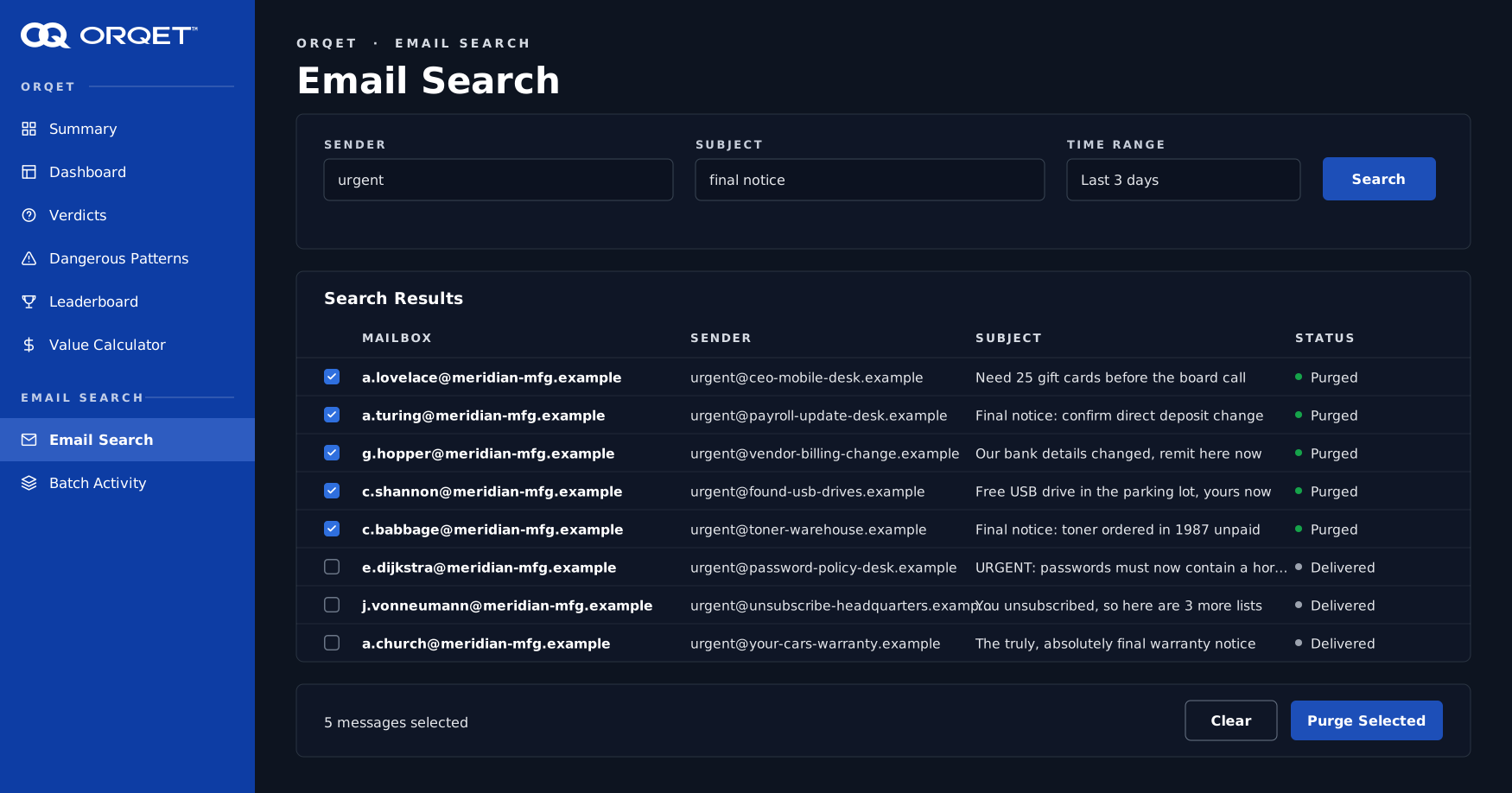
Representative interface shown with synthetic data. A live demonstration is recommended.

32% OF USER-REPORTED EMAILS CONFIRMED DANGEROUS AFTER A SECURE EMAIL GATEWAY AND AN INTEGRATED CLOUD EMAIL SECURITY LAYER.*

*Approximate figure, measured in the first month following deployment. Single enterprise customer environment. User-reported and analyst-confirmed. Customer identity withheld.

One Approach, Stronger Outcomes

Organizations invest heavily in preventing email threats before they reach the inbox. Modern email security platforms stop large volumes of malicious emails every day, yet even the strongest prevention strategies recognize one reality: some threats will still reach users. That is where a different operational challenge begins.

Too often, employees are expected to decide whether an email is safe without the context, tools, or expertise required to make that decision consistently. A single click can determine whether an isolated email becomes a broader security incident or a quickly resolved investigation.

ORQET transforms that uncertainty by addressing what happens when suspicious emails reach the inbox. Whether an email is reported by a user or identified through Inline detection, ORQET delivers a human-derived verdict, remediates confirmed threats based on the deployment model, and captures tactical and technical threat intelligence from confirmed attacks.

The result is more than resolving individual email investigations. It is a repeatable Post-Delivery Email Threat Response capability that reduces manual effort, expands visibility, supports faster remediation, and turns confirmed attacks into threat intelligence.

The Missing Layer in Email Security

Email security technologies work to prevent and detect threats, but suspicious emails still reach users. The gap begins when a user looks at an email and asks,

“Is This Safe?”

ORQET provides control over what happens next, turning that user report into a clear verdict and, when malicious, remediation and threat intelligence.

EXISTING EMAIL SECURITY

THE MISSING LAYER

CONTROL WITH ORQET

1

PREVENT & DETECT

Existing email security works to prevent threats and detect malicious activity before and after delivery.

2

USER CONFIDENCE

A suspicious email reaches the inbox and the user needs to know: Is this safe or malicious?

3

VERDICT

A human-derived verdict gives the user a clear answer.

4

REMEDIATE

When malicious, Search and Purge removes matching emails from affected mailboxes.

5

THREAT INTELLIGENCE

Confirmed attacks become tactical and technical threat intelligence.

Why Prevention Alone Is Not Enough

Why It Matters

The Challenge Does Not End When an Email Reaches the Inbox.

Prevention stops most of what arrives. What gets through still has to be investigated, confirmed, and acted on.

Organizations invest heavily in blocking phishing and business email compromise before delivery. Those investments are essential, but none stop everything. Eventually, a suspicious email reaches an employee, and the problem changes shape.

The employee is expected to judge whether the email is legitimate. The security team is expected to investigate quickly, reach a verdict, execute the right response, understand who else was affected, and tell the person who reported it what happened.

That burden looks different in every program. Some teams struggle with inconsistent investigations. Others face rising volume, limited visibility, disconnected response processes, growing executive reporting requirements, or pressure to show measurable results. The specifics differ. The work does not.

That work cannot rest on individual judgment. It requires one defined way of working that turns every reported email into a clear verdict, automated remediation, visibility leadership can use, and outcomes that improve the next investigation.

That is why Post-Delivery Email Threat Response has become part of a modern email security strategy. The question is no longer whether a threat reached the inbox. It is what happens next.

Deployment Model

Choose the ORQET Deployment Model That Fits Your Organization

Every organization shares the same objective: a trusted Post-Delivery Email Threat Response capability. ORQET delivers that capability through three deployment models built on one operating model.

Every organization has different requirements, existing security investments, and response objectives. Some organizations need trusted, human-validated investigations. Others require automated remediation across mailboxes. Some organizations require inline detection and response capabilities.

ORQET was designed to support each of these needs without changing the underlying operating model.

Every deployment model is built on the same governed operating model that delivers trusted threat validation, consistent investigations, coordinated response, deeper visibility, stronger security outcomes, and continuous improvement.

The difference is not the philosophy. It is the level of capability each deployment model delivers.

Organizations select the deployment model that best aligns with their security strategy and requirements.

Business IMPACT

Better Response Shows Up in Business Results.

Email threats are handled by security. The consequences are not.

What starts as one reported email can touch business continuity, executive confidence, and the organization’s risk position.

Volume is not the measure. Closing more investigations means little if the one that mattered was missed. What counts is what did not happen.

Reduced Organizational Risk

Reduce the likelihood that a confirmed threat persists in the environment.

Business Continuity

Purge matching malicious emails organization-wide.

Executive Confidence

Give leadership executive reporting they can present without translation.

Greater Value from Existing Security Investments

Get more from the email security you already own by adding response to filtering.

Security EFFECTIVENESS

One Standard, Applied Every Time.

Reporting a suspicious email takes a click. Reaching a verdict that holds up takes analysis.

Spotting something suspicious is where detection ends. The harder part starts after: establishing what the email actually is, and doing it the same way whether it arrives on a Tuesday morning or a holiday weekend.

Trained analysts reach the verdict on what users report. Remediation reaches everywhere the message landed, not just the mailbox that flagged it.

An answer that changes depending on who is on duty is not a standard.

Human in the Loop

A verdict requires human judgment, keeping human expertise at the center of the analysis.

Investigation Consistency

A verdict requires a consistent investigation, regardless of volume.

Automated Remediation

A verdict requires action when a threat is confirmed, including the removal of matching malicious emails from affected mailboxes.

Operational EFFICIENCY

Fewer Hours Per Case.

An email matching a known pattern does not need to start over. That is where hours come back.

As users become better trained to recognize and report suspicious emails, reporting volume can increase. That is a positive outcome, but it also creates more work for the security team, while headcount usually does not increase with it. Without a way to recognize previously reviewed emails, security teams can end up analyzing the same threat each time it is reported. ORQET changes that by recognizing previously analyzed emails and applying established human-derived verdicts, reducing repeat work as reporting volume grows.

By applying established human-derived verdicts when previously analyzed emails appear again, ORQET reduces repetitive analysis while dashboards provide visibility into activity and trends over time.

In an effective operation, the work done today should reduce repeat work tomorrow.

Workload

Cut repeat effort on submissions matching patterns already seen.

Analyst Focus

Free the team from repetitive tasks so they can take on higher-value security priorities.

Operational Visibility

Show performance and trends in the ORQET dashboard people actually open.

Continuous Improvement

Feed every finding into threat intelligence that speeds the next investigation.

Operational Maturity

Build a repeatable capability that holds up as the operation scales.

Challenges

Different Challenges. One Operating Model.

Every organization faces unique challenges, but trusted outcomes depend on the same consistent approach.

Every organization experiences different pressures, but the need for trusted outcomes remains constant.

Some security teams struggle with inconsistent investigations. Others face increasing workloads, limited visibility, disconnected response processes, growing executive reporting requirements, or pressure to demonstrate measurable security outcomes. While the challenges differ, the objective remains the same.

Security leaders need trusted outcomes that enable confident decisions, coordinated response, meaningful operational visibility, and continuous improvement across the entire security operation.

ORQET provides a governed operating model that transforms reported and detected email threats into disciplined investigations, trusted outcomes, coordinated response, and continuously improving security performance.

Rather than solving individual problems in isolation, ORQET establishes a repeatable governed operational capability that strengthens every aspect of Post-Delivery Email Threat Response.

OPERATIONAL CHALLENGES

Investigation Consistency

Create repeatable investigation processes that improve quality, strengthen confidence, and reduce variability.

Workload

Reduce unnecessary effort by delivering trusted outcomes through disciplined execution and reusable intelligence.

Coordinated Response

Improve organizational consistency by ensuring decisions are executed through governed response processes.

Operational Visibility

Provide meaningful insight that enables leadership to understand performance, identify trends, and confidently guide future improvements.

Executive Confidence

Deliver trusted outcomes that provide executive leadership with greater confidence in the organization’s ability to manage email threats consistently.

Continuous Improvement

Transform experience and determinations into continuous improvements that strengthen the security operation over time.

Security OperationS

Build More Resilient Security Operations

The future of email security is not defined by prevention alone. It is defined by what happens after a threat reaches the inbox.

Every organization shares the same objectives:

  • Reduce risk.
  • Strengthen security operations.
  • Operate with greater confidence.
  • Strengthen organizational resilience.

Achieving those outcomes requires more than preventing threats before they reach the inbox. It requires a disciplined capability that consistently confirms threats, investigates with confidence, coordinates response, provides meaningful visibility, and continuously strengthens future performance.

ORQET delivers that capability through a governed model for Post-Delivery Email Threat Response, transforming every reported or detected email into trusted outcomes.

Whether your organization selects Core, Advanced, or Inline, every deployment model is built on the same governed operating model designed to strengthen business resilience, improve security, and continuously improve outcomes.

Different challenges.
One governed operating model.
Stronger outcomes with every trusted decision.

Ready to See What Changes With Each Model?

Post-Delivery Email Threat Response is a requirement. How much of it you run yourself is a choice.

Compare Core, Advanced, and Inline side by side, or tell us how you work today and we will point you to the right one.

“We didn’t replace our security stack. We finally connected it.”

Director, Security Engineering, Manufacturing